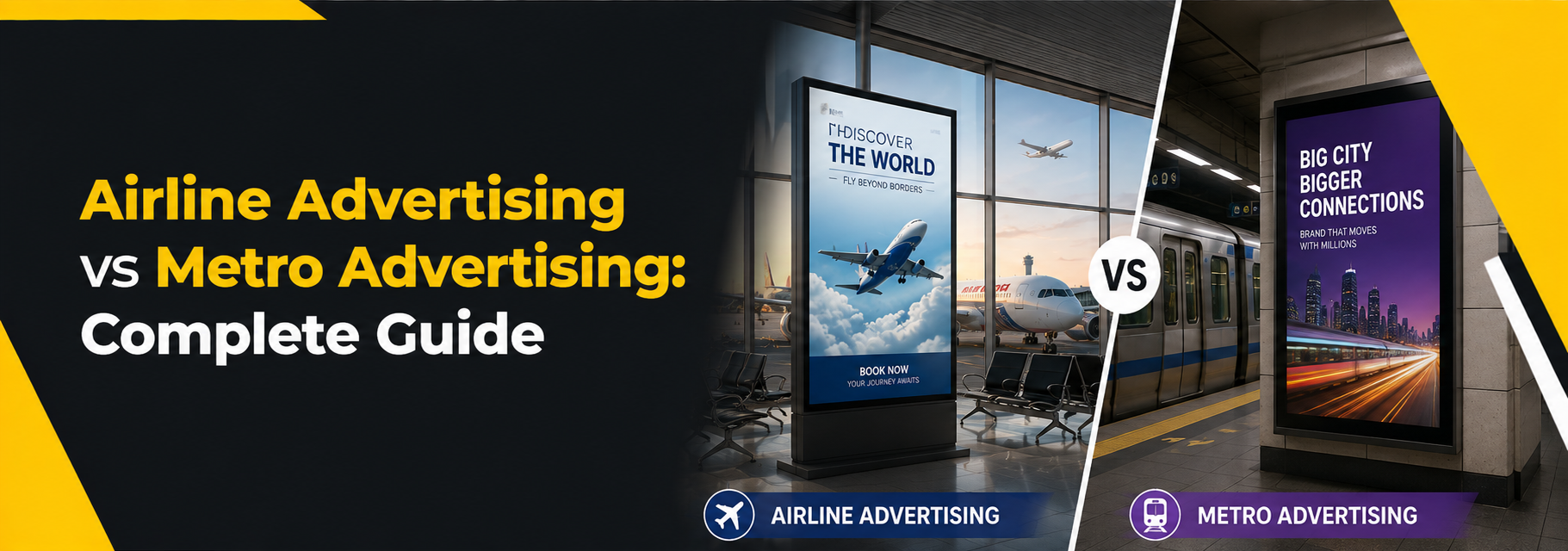
Airline Advertising vs Metro Advertising: Complete Guide
For modern brands, choosing the right advertising medium is not simply about finding the largest audience. It is about understanding where the audience is, how long they are exposed to the message, what mindset they are in, and what kind of brand experience the medium can create.
Two highly valuable but very different channels are airline advertising and metro advertising.
Airline advertising reaches passengers in airports, aircraft cabins, inflight magazines, digital entertainment systems, boarding areas, lounges, and other aviation touchpoints. Metro advertising, on the other hand, reaches commuters across metro stations, trains, platforms, concourses, entrances, exits, and transit corridors.
Both are forms of high-visibility advertising, but they serve different marketing purposes.
Airline advertising can provide access to an audience that is often traveling for business, leisure, premium experiences, or important personal occasions. Metro advertising can provide repeated exposure to large urban audiences during daily commuting journeys.
So, which one is better?
The answer depends on your campaign objective, target audience, geography, budget, creative strategy, and desired frequency.
This complete guide compares airline advertising and metro advertising, explains the major formats available in both media, examines their advantages and limitations, and provides a practical framework for deciding where your brand should invest.
What Is Airline Advertising?
Airline advertising refers to advertising opportunities associated with airlines and the passenger journey.
It can include advertising across different touchpoints, such as:
✓ Inflight magazines
✓ Inflight entertainment systems
✓ Seat-back screens
✓ Tray tables
✓ Cabin branding
✓ Headrest covers
✓ Boarding passes
✓ Airport lounges
✓ Airport terminals
✓ Airline websites and apps
✓ Airline newsletters
✓ Passenger communication channels
✓ Baggage-related advertising
✓ Onboard announcements or sponsored content, where available
✓ Airport-to-airline integrated campaigns
Airline advertising is therefore broader than simply placing an advertisement inside an aircraft.
The passenger journey begins before boarding and continues after landing. Brands can use different touchpoints to build an integrated campaign around that journey.
For example, a premium travel company could combine airport branding with inflight advertising and digital retargeting to create multiple interactions with the same audience.
What Is Metro Advertising?
Metro advertising is a form of out-of-home advertising placed across metro rail systems.
It can include advertising inside and outside metro trains as well as throughout stations.
Common formats include:
✓ Metro train wraps
✓ Train interior panels
✓ Platform advertising
✓ Station wall branding
✓ Pillar advertising
✓ Concourse advertising
✓ Entry and exit branding
✓ Escalator branding
✓ Staircase branding
✓ Digital screens
✓ LED displays
✓ Backlit panels
✓ Station domination
✓ Train domination
✓ Ticket-area advertising
✓ Transit-media campaigns
Metro advertising is particularly powerful in cities with high public-transport usage because commuters may encounter the same campaign repeatedly during their daily journeys.
Airline Advertising vs Metro Advertising at a Glance
| Factor | Airline Advertising | Metro Advertising |
|---|---|---|
| Environment | Aviation/travel | Urban transit |
| Audience | Passengers/travelers | Daily commuters |
| Exposure | Journey-based | Often repeated |
| Geography | Airport/route/network dependent | City/metro network dependent |
| Mindset | Travel/business/leisure | Commuting/daily routine |
| Premium perception | Often high | Depends on location/format |
| Frequency | Usually lower | Potentially very high |
| Large-format branding | Airport-focused | Station/train-focused |
| Long-form content | Possible in magazines/entertainment | Usually limited |
| Local targeting | Airport/network based | Station/line based |
| Best for | Premium, travel, national brands | Mass urban reach, local and national brands |
| Creative style | Premium/storytelling | Bold, simple, high-impact |
| Repetition | Moderate | Often strong |
| Dwell time | Can be significant | Varies by station and journey |
Neither medium is universally superior.
The important question is:
Which medium matches your marketing objective?
Why Airline Advertising Is Attractive to Brands
Airline advertising has a unique advantage: the audience is already in a travel-oriented environment.
A passenger may be thinking about:
✓ Business
✓ Holidays
✓ Hotels
✓ Shopping
✓ Finance
✓ Technology
✓ Food
✓ Luxury
✓ Transportation
✓ Experiences
✓ New destinations
This creates opportunities for brands whose products naturally align with travel and premium consumption.
But airline advertising is not limited to travel companies.
Brands from industries such as:
✓ Banking
✓ Automotive
✓ Real estate
✓ Consumer electronics
✓ Luxury
✓ Fashion
✓ Education
✓ Technology
✓ Healthcare
✓ Financial services
may also use aviation environments for brand building.
Why Metro Advertising Is Attractive to Brands
Metro advertising has a different strength: repeated urban exposure.
A commuter may travel through the same station every day.
They may see the same:
✓ Billboard
✓ Digital screen
✓ Platform panel
✓ Train wrap
✓ Pillar branding
multiple times over a campaign period.
This repetition can help build familiarity.
For example, if a commuter sees the same brand advertisement every morning while entering a metro station, the brand can become visually familiar even without an immediate purchase.
Metro advertising is therefore particularly valuable for:
✓ FMCG
✓ Retail
✓ Education
✓ Real estate
✓ Restaurants
✓ Apps
✓ E-commerce
✓ Financial services
✓ Telecommunications
✓ Automotive
✓ Consumer electronics
✓ Local businesses
Audience Difference: Travelers vs Commuters
The biggest difference between airline and metro advertising is the audience context.
Airline Audience
Airline passengers are generally in a travel environment.
Depending on the route and service, they may include:
✓ Business travelers
✓ Tourists
✓ Families
✓ Students
✓ Professionals
✓ International travelers
✓ Domestic travelers
✓ Premium travelers
The audience composition can vary significantly by airline, airport, route, cabin class, season, and destination.
Metro Audience
Metro audiences are predominantly urban transit users.
They may include:
✓ Office employees
✓ Students
✓ Professionals
✓ Shoppers
✓ Tourists
✓ Local residents
✓ Business owners
✓ Daily commuters
Metro advertising therefore tends to provide stronger access to everyday urban populations.
Airline Advertising for Premium Brands
One of the biggest strengths of aviation media is the ability to create a premium environment.
The physical context matters.
A brand appearing within an aviation journey can benefit from the perception of:
✓ Travel
✓ Progress
✓ Premium experiences
✓ Business
✓ Mobility
✓ Aspirational lifestyles
This makes airline and airport advertising particularly interesting for luxury and premium brands.
For example, a luxury watch brand could use aviation advertising to communicate exclusivity and sophistication.
Similarly, a premium automobile company could use airport or airline media to reach affluent travelers.
Metro Advertising for Mass Urban Visibility
Metro advertising is particularly effective when the goal is broad urban visibility.
A metro system can connect:
✓ Residential areas
✓ Business districts
✓ Shopping destinations
✓ Educational institutions
✓ Tourist areas
✓ Commercial hubs
A campaign placed strategically along a high-traffic metro corridor can generate substantial repeated visibility.
This makes metro advertising attractive for brands that want to become familiar to a large urban population.
Frequency: A Major Advantage of Metro Advertising
Frequency is one of the strongest arguments for metro advertising.
A daily commuter may pass the same advertisement repeatedly.
For example:
Monday: sees the campaign.
Tuesday: sees it again.
Wednesday: sees it again.
Thursday: notices the message more clearly.
Friday: remembers the brand.
This repeated exposure can reinforce brand recognition.
Airline branding can provide strong exposure, but passenger frequency is generally different. A traveler may see a campaign during one trip and then not encounter it again for some time.
Therefore:
Metro = repetition advantage
Airline = journey and environment advantage
Dwell Time and Attention
Exposure is not simply about how many people pass an advertisement.
The amount of time people spend near the advertisement also matters.
At metro stations, passengers may wait for:
✓ Trains
✓ Platform access
✓ Ticketing
✓ Connections
This can provide additional opportunities to notice advertising.
At airports and during flights, passengers can also experience significant periods of waiting and travel.
Inflight magazine advertising can be particularly interesting because passengers may have extended periods in which they are physically separated from their normal daily environment.
However, actual attention varies by passenger behavior.
A passenger may:
✓ Read
✓ Sleep
✓ Watch entertainment
✓ Use a phone
✓ Work
✓ Talk
✓ Eat
✓ Browse content
Therefore, advertisers should design creative around realistic attention patterns rather than assuming everyone is actively looking at an advertisement.
Geography: Which Medium Offers Better Targeting?
Geography is another major difference.
Metro Advertising
Metro advertising can be highly useful for city-level targeting.
A brand can select:
✓ Specific stations
✓ Metro lines
✓ Business districts
✓ Residential areas
✓ High-footfall stations
✓ Interchange stations
For example, a real estate company launching a project in Noida might want advertising near metro stations used by its target audience.
Airline Advertising
Airline advertising can be targeted around:
✓ Specific airports
✓ Airlines
✓ Routes
✓ Domestic networks
✓ International networks
✓ Passenger segments
✓ Premium travel environments
For a tourism campaign, route-based targeting can be particularly valuable.
Airline Advertising for National and International Brands
Airline media can be useful for brands with national or international ambitions.
A campaign across major airports can provide exposure to audiences from multiple cities and regions.
This can be especially relevant for:
✓ Global companies
✓ Tourism brands
✓ Financial institutions
✓ Luxury companies
✓ Technology brands
✓ Automotive companies
✓ National consumer brands
However, campaign scale and inventory availability depend on the specific airports, airlines, media owners, routes, and formats selected.
Metro Advertising for Local and Regional Businesses
Metro advertising can also be highly effective for businesses with a local footprint.
Consider:
Restaurant → Advertise near nearby stations
College → Target stations used by students
Real estate → Target stations near the development
Retailer → Advertise along shopping corridors
Hospital → Target stations around its catchment area
This ability to connect media locations with actual business locations is a major advantage.
Creative Strategy for Airline Advertising
Airline advertising should generally take advantage of the travel environment.
Creative themes can include:
✓ Aspirational experiences
✓ International lifestyles
✓ Business success
✓ Premium products
✓ Travel
✓ Luxury
✓ Convenience
✓ Discovery
For inflight magazines, brands may have more room for detailed storytelling than on a rapidly passing outdoor advertisement.
Longer-form creative can potentially communicate:
- Product features
- Brand stories
- Destination information
- Luxury experiences
- Detailed offers
But digital and screen-based airline formats may require much shorter creative.
Creative Strategy for Metro Advertising
Metro advertising usually requires immediate visual communication.
A commuter may see an advertisement while walking.
Therefore, the creative should often communicate the main message quickly.
Use:
Large headline
Strong visual
Recognizable brand
Short CTA
For example:
"New Home Near Noida Metro"
is easier to process quickly than a paragraph explaining an entire real estate project.
Why Simple Creative Works in Metro Advertising
Imagine a commuter walking past a station panel.
They may have only a few seconds to notice it.
The advertisement needs to communicate:
Who are you?
What are you offering?
Why should I care?
What should I do next?
This is why metro advertising often benefits from bold typography and simple visual hierarchy.
Which Medium Is Better for Branding?
Both can be excellent for branding, but they create different types of brand associations.
Airline Advertising
Often works well for:
✓ Premium positioning
✓ Aspirational branding
✓ Business audiences
✓ Travel-related storytelling
✓ National/international positioning
Metro Advertising
Often works well for:
✓ Mass awareness
✓ Urban visibility
✓ Repeated exposure
✓ Local market penetration
✓ Everyday brand familiarity
If the objective is to make a brand feel premium and aspirational, aviation can be particularly attractive.
If the objective is repeated visibility across a city, metro can be highly effective.
Which Medium Is Better for Product Launches?
Both can support launches.
The better option depends on the product.
Airline
Suitable for launches targeting:
- Premium consumers
- Business travelers
- International audiences
- Affluent segments
- Travel-related consumers
Metro
Suitable for launches targeting:
- Urban consumers
- Students
- Young professionals
- Mass-market audiences
- Local customers
A product launch can also use both.
For example:
Airport/airline → Premium launch positioning
Metro → Mass urban awareness
Digital → Conversion
This creates a broader media ecosystem.
Airline Advertising vs Metro Advertising for Real Estate
Real estate is a particularly interesting category because both media can work.
Metro
Metro advertising can target people living and working near the project.
It can communicate:
- Location
- Connectivity
- Starting price
- Project name
- Sales contact
Airline/Airport
Airport advertising can help premium developers build brand perception and reach high-value audiences.
It can communicate:
- Luxury
- Lifestyle
- Premium residences
- Investment opportunities
- Brand reputation
For a luxury real estate developer, airport branding can strengthen premium positioning.
For a mass-market residential project, metro may provide more relevant local reach.
Airline Advertising vs Metro Advertising for Automotive Brands
Automotive companies can use both media differently.
Metro
Useful for:
- New model awareness
- Urban commuter audiences
- Electric vehicle campaigns
- Dealer-area awareness
- Mass-market launches
Airline/Airport
Useful for:
- Premium vehicle positioning
- Luxury launches
- Corporate branding
- High-income audiences
- National campaigns
The creative should reflect the environment.
Metro creative can focus on:
Mileage + price + features + convenience
Airport creative might focus more on:
Luxury + design + technology + aspiration
Airline Advertising vs Metro Advertising for Education
Education brands often benefit strongly from metro advertising because students and working professionals are regular commuters.
Potential audiences include:
- College students
- Competitive exam aspirants
- Professionals
- Parents
- Young adults
Metro campaigns can use station-level targeting near educational hubs.
Airline advertising may make more sense for:
- International education
- Executive education
- Premium institutions
- Business schools
- International universities
Again, audience relevance should determine the medium.
Cost Considerations
One of the most common questions is:
Which is cheaper—airline advertising or metro advertising?
There is no universal answer.
Costs depend on:
✓ Location
✓ Format
✓ Campaign duration
✓ Inventory
✓ Audience
✓ Season
✓ Media owner
✓ Exclusivity
✓ Production
✓ Installation
✓ Creative requirements
✓ Campaign scale
A single premium airport or airline placement can be expensive.
Likewise, a major metro station takeover or full train branding can require a substantial investment.
Instead of comparing only the headline media rate, calculate the complete campaign economics.
Consider:
Media cost + production + installation + agency fees + duration + expected reach + frequency
Measuring Airline Advertising vs Metro Advertising
| No. | Airline Advertising – Key Metrics | Metro Advertising – Key Metrics |
|---|---|---|
| 1 | Estimated audience | Estimated footfall |
| 2 | Passenger reach | Passenger reach |
| 3 | Impressions | Station traffic |
| 4 | Publication circulation | Train ridership |
| 5 | Digital views | Campaign duration |
| 6 | Engagement | Geographic coverage |
| 7 | QR-code scans | Frequency |
| 8 | Website traffic | QR scans |
| 9 | Search uplift | Website traffic |
| 10 | Brand awareness | Search interest |
| 11 | Lead generation | Brand lift |
| 12 | Delayed brand/search response | Store visits |
Measurement Note: For brand campaigns, measurement should extend beyond direct clicks. A traveler may see an advertisement and search for the brand several days later. Similarly, metro campaigns should consider audience estimates, frequency, geographic coverage, and downstream business impact. Where available, advertisers should review media-owner reports and understand the methodology used to calculate audience estimates.
Airline Advertising and Digital Integration
One powerful strategy is to combine physical aviation advertising with digital marketing.
For example:
Airport branding
↓
Inflight advertisement
↓
QR code / website
↓
Digital retargeting
↓
Lead or purchase
This creates a connected customer journey.
The same principle can work with metro advertising.
Metro Advertising and Digital Integration
Imagine a commuter sees a metro advertisement for a new smartphone.
Later, they search for the product online.
They then see:
- Search advertising
- Social media content
- Display ads
- Product reviews
The physical advertisement creates initial awareness, while digital channels support consideration and conversion.
This is why OOH should not be treated as an isolated medium.
Combining Airline and Metro Advertising
For some brands, the best answer is not "airline or metro."
It is:
Airline + Metro + Digital.
Consider a national consumer brand launching a new product.
Phase 1 — Airline
Build premium awareness among travelers.
Phase 2 — Metro
Create repeated visibility across major cities.
Phase 3 — Digital
Capture searches and website visits.
Phase 4 — Retail
Convert awareness into purchase.
This integrated approach can create a stronger media ecosystem than relying on one channel.
Which Medium Provides Better Brand Recall?
Brand recall depends on:
- Creative quality
- Frequency
- Audience relevance
- Environment
- Campaign duration
- Message simplicity
Metro's repetition can be powerful.
Airline's contextual environment can be powerful.
If a commuter sees an advertisement every day, recall may increase through repetition.
If a traveler encounters a memorable premium campaign during a major trip, the context itself may strengthen the memory.
There is no universal winner.
Which Is Better for Premium Brands?
For premium positioning, airline and airport advertising can have a strong advantage because the environment itself can support premium brand associations.
Luxury:
- Watches
- Automobiles
- Fashion
- Hospitality
- Real estate
- Financial services
can benefit from this positioning.
However, premium brands can also use premium metro stations and large-format metro branding effectively.
The key is choosing the right location and format.
Which Is Better for Mass Awareness?
Metro advertising generally has an advantage when the objective is repeated urban mass visibility, particularly in cities with extensive metro networks.
A strategically selected campaign can cover:
- Multiple stations
- Major interchanges
- Entire train interiors
- Entire trains
- High-traffic corridors
This can create significant visual presence.
Which Is Better for Frequency?
Generally, metro advertising has the stronger frequency advantage because commuters often repeat the same journeys.
Airline advertising is more journey-specific.
However, airline campaigns across multiple airports, routes, publications, and digital touchpoints can still generate significant cumulative exposure.
Which Is Better for Storytelling?
This depends on the format.
Inflight magazines and certain digital airline environments can support longer storytelling.
Metro advertising is generally stronger for quick, visual communication.
For detailed product explanations, digital video may complement either medium.
How to Choose Between Airline and Metro Advertising
Use this simple framework.
Choose Airline Advertising If:
- Your audience travels frequently.
- You target premium consumers.
- You want an aspirational environment.
- Your campaign is national or international.
- Your product is associated with travel or luxury.
- You want aviation-related brand association.
- You can benefit from airport and inflight touchpoints.
Choose Metro Advertising If:
- Your target audience lives in a major metro city.
- You want repeated exposure.
- You need strong local visibility.
- Your audience consists of commuters.
- You want station-level targeting.
- Your product is mass-market or urban-focused.
- You want strong daily visibility.
Questions to Ask Before Buying Media
Before signing an advertising campaign, ask:
1. Who exactly is the audience?
Do not buy media simply because the location is famous.
2. How many people will realistically see the campaign?
Request available audience estimates.
3. What is the expected frequency?
A campaign with high reach but low frequency may behave differently from one with lower reach and high repetition.
4. What is the exact placement?
Ask for:
- Station
- Terminal
- Route
- Train
- Format
- Position
5. What is the campaign duration?
One week and three months can create very different outcomes.
6. What production costs are involved?
Include printing, fabrication, installation, removal, and creative adaptation where applicable.
7. Can the campaign be integrated with digital?
Look for opportunities to connect offline exposure with online action.
Common Mistakes in Airline Advertising vs Metro Advertising
| No. | Airline Advertising – Common Mistakes | Metro Advertising – Common Mistakes |
|---|---|---|
| 1 | Choosing a placement only because it is premium: A premium location is not useful if the audience is irrelevant. | Too much text: Commuters cannot read a brochure from a wall. |
| 2 | Using overly detailed creative: Passengers may not have time to read a complex message. | Poor contrast: The message can disappear in a busy station environment. |
| 3 | Ignoring passenger journey: Different touchpoints provide different advertising opportunities. | Weak branding: People may remember the advertisement but not the brand. |
| 4 | Focusing only on impressions: Brand impact may matter more than raw volume. | Choosing stations without audience research: High footfall does not automatically mean high relevance. |
| 5 | Not integrating digital: QR codes, websites, search campaigns, and retargeting can extend the campaign. | Ignoring frequency: One isolated placement may not create enough repetition. |
| 6 | — | Forgetting the surroundings: The advertisement should work visually within the actual station environment. |
Best Practices for Airline Advertising vs Metro Advertising
| No. | Airline Advertising | Metro Advertising |
|---|---|---|
| 1 | Match the placement to your target passenger. | Choose stations based on audience relevance. |
| 2 | Use premium visual design where appropriate. | Prioritize high-traffic routes when mass reach is important. |
| 3 | Keep the main message clear. | Use bold visuals. |
| 4 | Use strong branding. | Keep copy short. |
| 5 | Consider multilingual creative for Indian audiences. | Make the brand immediately recognizable. |
| 6 | Integrate airport, airline, and digital touchpoints where possible. | Use strong contrast. |
| 7 | Measure both exposure and downstream impact. | Consider train and station domination for major launches. |
| 8 | Build campaigns around the passenger journey. | Plan enough duration to build repetition. |
| 9 | Use QR codes or digital CTAs where appropriate. | Combine OOH with digital campaigns. |
| 10 | Select media based on audience relevance rather than prestige alone. | Measure campaign impact against business objectives. |
Airline vs Metro: Final Decision Matrix
| Marketing Objective | Better Starting Point |
|---|---|
| Premium brand positioning | Airline/Airport |
| Luxury product launch | Airline/Airport |
| Daily urban visibility | Metro |
| Local city campaign | Metro |
| International brand | Airline/Airport |
| Student targeting | Metro |
| Business traveler targeting | Airline/Airport |
| Repeated commuter exposure | Metro |
| Travel brand | Airline/Airport |
| Mass urban awareness | Metro |
| Premium real estate | Airline/Airport |
| Local real estate | Metro |
| International education | Airline/Airport |
| Local education | Metro |
| National integrated campaign | Both |
The Best Strategy May Be Both
Modern media planning should not always be based on choosing one channel.
Airline and metro branding can complement each other.
Imagine a technology brand launching a premium smartphone in India.
Airline Campaign: The brand uses airport and inflight advertising to create premium positioning among travelers and professionals.
Metro Campaign: The brand uses major metro stations in Delhi, Mumbai, Bengaluru, Hyderabad, and other cities for high-frequency visibility.
Digital Campaign: Search, social, video, and display advertising capture consumer interest.
Retail Campaign: The product is promoted at stores and e-commerce platforms. The result is a connected campaign rather than isolated advertisements.
Conclusion
Airline advertising and metro advertising are both powerful OOH and transit-media opportunities, but they work in fundamentally different environments.
Airline advertising is particularly valuable when a brand wants to reach travelers, business audiences, premium consumers, or audiences in a travel-oriented environment. It can provide strong opportunities for aspirational storytelling and premium brand positioning across airports, airlines, inflight magazines, entertainment systems, and other passenger touchpoints.
Metro advertising is particularly powerful for brands seeking repeated urban exposure. Daily commuters can encounter the same campaign repeatedly across stations, trains, platforms, and transit corridors. This makes metro advertising especially useful for mass awareness, local targeting, city launches, retail campaigns, education, real estate, FMCG, and consumer services.
The right choice therefore depends on your objective.
If your priority is premium positioning, traveler audiences, and an aspirational environment, airline advertising may be the stronger choice.
If your priority is repeated urban exposure, commuter reach, and city-level visibility, metro advertising may be more effective.
And if you are running a large integrated campaign, you do not necessarily have to choose.
Airline + Metro + Digital + Other OOH channels can work together to create a stronger customer journey.
The most important lesson is simple:
Do not choose an advertising medium because it looks impressive. Choose it because its audience, environment, frequency, geography, and format match your marketing objective.
A successful campaign starts with the audience, builds the right message for that audience, selects the appropriate media environment, and then measures the result.
Whether you choose an airport terminal, inflight magazine, metro station, metro train, digital screen, or a combination of all of them, strategic planning is what turns advertising space into meaningful brand exposure.
Frequently Asked Questions
1. Is airline advertising better than metro advertising?
Neither is universally better. Airline advertising is often stronger for traveler, premium, and aspirational audiences, while metro advertising can be stronger for repeated urban and commuter exposure.
2. Is metro advertising suitable for small businesses?
Yes. Businesses with a local customer base can use selected metro stations to reach relevant geographic markets, provided the audience and campaign economics make sense.
3. Is airline advertising only for luxury brands?
No. While premium brands can benefit from the environment, airlines and airport media can also be used by technology, education, finance, automotive, travel, consumer, and national brands.
4. Which advertising medium provides higher frequency?
Metro advertising generally has a strong frequency advantage because daily commuters may repeatedly encounter the same campaign. Actual frequency depends on the selected media plan.
5. Can airline advertising target specific cities?
Campaigns can often be planned around specific airports, routes, airlines, or networks, subject to inventory availability and media-owner capabilities.
6. Can metro advertising target specific areas?
Yes. Depending on the metro system and media inventory, advertisers can often select particular stations, lines, corridors, or station clusters.
7. Which is better for real estate advertising?
Metro advertising can be highly effective for location-based real estate campaigns, while airport or airline advertising can work well for premium developers and broader brand positioning.
8. What type of creative works best in metro advertising?
Short, bold, visually clear creative usually works well because commuters may only have a few seconds to notice an advertisement.
9. What type of brands benefit from airline advertising?
Travel, hospitality, luxury, automotive, financial services, technology, real estate, education, and national or international brands can potentially benefit depending on the audience and campaign objective.
10. Can airline and metro advertising be used together?
Absolutely. Combining airline, metro, digital, airport, outdoor, and other media can create a broader integrated advertising campaign when the target audience and budget justify it.